What It Is, Why It Matters, and How to Use It Right
If you've ever wired a building for card readers, door strikes, motion sensors, and door contacts, you already know what a hassle it can be pulling separate cables for each device. Not only is it time-consuming, but it clutters your pathways and fills up your boxes fast. That's where access control composite cable comes in.
Composite cable isn't new, but it's now the go-to for most commercial access control installs. Whether it's a simple office or a multi-door healthcare facility, composite cable cuts labor, simplifies termination, and speeds up the job.
Access Control Composite Cable Anatomy
One cable replaces 4-5 separate pulls per door
What Is Access Control Composite Cable?
Access control composite cable is a single bundled cable that contains all the conductors needed to wire a typical access-controlled door. Inside, you'll find power conductors for electric locks, twisted pairs for card readers, door contact wiring, and additional pairs for REX (request to exit) or future spares. Instead of pulling four or five separate cables per door, you pull one, saving time, space, and headache.
These cables come with individual color-coded, labeled elements and are bundled inside a common outer jacket. They're available in both plenum (CMP) and riser (CMR) rated versions so they meet fire code requirements depending on your install environment.
Why Composite Cable Became the Industry Standard
There was a time when access control wiring meant running individual cables for every function: one for the reader, one for the strike, another for the contact, and so on. That's how many techs were trained, and it worked fine… until it didn't. As systems grew more complex and code enforcement became stricter, pulling multiple cables became inefficient and messy.
Composite cable became the standard because it's just better for modern installs. You get faster labor with a single pull, neater cable trays and conduit fills, and a lot less confusion when terminating. It also makes service and troubleshooting easier because the wire paths are consistent and easy to identify. The final product looks more professional, too, something your GC and end client will both appreciate. To size pathways for composite vs individual runs, use the free conduit fill calculator.
What's Inside an Access Control Composite Cable?
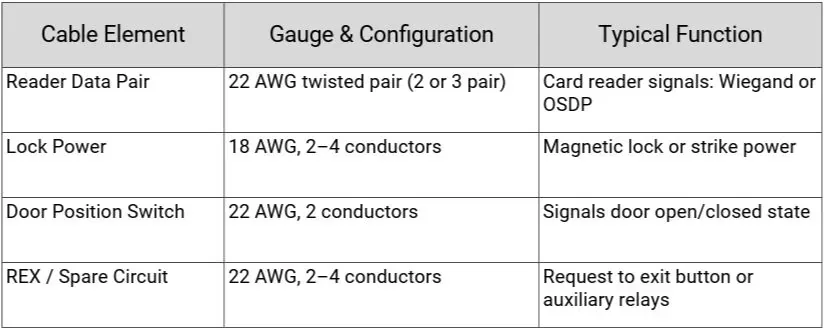
Here's a typical cable breakdown:
Most access composite cables also include shielding on the data pairs, rip cords for easy stripping, and a drain wire to ground any signal interference, all helping ensure signal quality and clean terminations.
Real-World Use: Easier Pulls, Faster Jobs
Let's say you're wiring a 30-door building. If you're not using access control composite cable, that might mean 120 individual cable pulls. That's a ton of labor, not to mention the strain on your sleeves, junction boxes, and conduits. With composite cable, you're pulling just one cable per door. Not only does that reduce install time significantly, it also makes for a cleaner, more maintainable system.
The time savings alone can be the difference between a profitable job and one that runs over on labor. It also allows a crew of two to cover more ground in less time, especially useful when deadlines are tight or you're working nights or weekends.
Fire Ratings: CMP vs. CMR
Choosing the right jacket rating for your install isn't optional. CMP, or plenum-rated cable, is required in areas where the cable will run through open airspaces used for HVAC return, like above drop ceilings in office buildings. It has a higher flame resistance and produces less smoke, which is critical for life safety.
CMR, or riser-rated cable, is used for vertical runs between floors where there's no airflow handling involved. It's less expensive but not safe, or compliant, for plenum spaces. Always check with the GC or engineer when you're unsure. If you're on the fence, choose plenum. It'll pass inspection and avoid delays if the AHJ flags it.
NEC Compliance and AHJ Considerations
While the NEC doesn't have a dedicated section specifically for "access control composite cable," Article 725 still governs how these cables are installed. You need to match the cable's fire rating to the environment, avoid running Class 2 power conductors too far or with excessive voltage drop, and make sure data and power pairs are kept separated where possible.
Labeling conductors at both ends is also important, especially for larger installs where dozens of doors terminate into a single head-end panel. If fire release circuits are involved, some AHJs require that those be run in separate, fire-rated pathways. Talk to your permitting office early and avoid last-minute rework.
OSDP, Wiegand & Signal Quality
A lot of new systems are moving to OSDP, and it's worth noting that cable quality matters more with encrypted, bi-directional communication. OSDP is more secure and supports features like device supervision, but it's also more sensitive to interference and bad wiring.
For OSDP readers, you should always use shielded twisted pairs for data, and try to keep them physically separated from high-voltage power conductors. Avoid routing reader cables near noisy devices like HVAC units or VFDs. Factory-bundled composite cables usually help with this by isolating reader pairs from lock power, but it's still worth checking specs.
Termination Tips from the Field
When it comes time to land wires, clean terminations save a ton of time later. Always label conductors right after stripping the jacket. Don't assume you'll "figure it out" later. Use labeled terminal blocks where possible and make sure there's enough slack at both ends to make service work easier down the road.
Keep reader and data pairs away from power conductors inside the enclosure, and avoid creating sharp bends or kinks in the twisted pairs. If you're wiring different types of doors, say, some with maglocks, others with strikes, always spec for the higher conductor count. It's better to have a few unused conductors than to realize you're one short halfway through a pull.
When Not to Use Composite Cable
There are a few situations where composite cable isn't the best choice. If you're wiring multiple doors back to a shared controller or power supply and the runs branch in different directions, individual cables might give you more flexibility. The same goes if the distance between devices on a single door is unusually long, say, if the reader is on the glass wall and the strike power needs to come from another room.
Composite cable can also be challenging in tight conduit where the overall cable diameter may become an issue. Lastly, if your electric locks draw more current than what 18 AWG conductors can handle, you'll need to run separate heavier-gauge power wires.
Composite vs. DIY Bundling
Some installers still try to bundle individual cables with electrical tape to mimic a composite setup. That might seem clever in the short term, but it causes more problems than it solves. Taped bundles often don't meet UL standards, violate code, and get flagged during inspections. They also tend to pull poorly, especially in conduit, and make a mess inside panels or J-boxes.
Factory-built composite cable is UL-listed, consistent, and purpose-built for the job. It's clean, code-friendly, and gives your low voltage wiring install the polish it needs to pass inspection and impress the client.
Final Thoughts: Why Access Control Composite Cable Pays Off
Composite cable isn't just a convenience. It's a smart investment in labor savings, code compliance, and project quality. It helps reduce install time, cable clutter, and headaches during troubleshooting. Your clients get a cleaner system, your techs spend less time tracing wires, and your company ends up looking more professional.
Whether you're bidding a 5-door system or wiring 80 openings across multiple buildings, access control composite cable helps you finish faster, reduce callbacks, and hit your deadlines with confidence.
Frequently Asked Questions
Frequently Asked Questions
Access control composite cable is a single bundled cable containing all the conductors needed to wire a typical access-controlled door — power conductors for electric locks, shielded twisted pairs for card readers, door contact wiring, and spare pairs for REX or future use. Instead of pulling four or five separate cables per door, installers pull one cable per opening, reducing labor time and conduit fill significantly.
Conductor count varies by manufacturer and application, but most commercial composite cables bundle 18 AWG power conductors for the lock, two or more shielded twisted pairs for the card reader data circuit, and additional pairs for door contacts and REX. Some configurations include eight or more total conductors in one jacket. Always verify the conductor count against your access control panel and lock specification before ordering.
CMP (plenum) rated cable is required in spaces used for HVAC air circulation, including the open plenum above most commercial drop ceilings. CMR (riser) rated cable is approved for vertical runs between floors where there is no airflow handling. CMP has a higher flame resistance and lower smoke rating than CMR. Using CMR in a plenum space violates NEC Article 800 and will be flagged by the authority having jurisdiction during inspection.
Yes, but you need to verify that the composite cable includes shielded twisted pairs for the RS-485 data circuit. OSDP uses a differential serial protocol that is more sensitive to noise than Wiegand, so the shielding on the reader pairs matters. Keep reader pairs physically separated from lock power conductors inside the terminal enclosure, and avoid routing near VFDs or HVAC equipment that generates electromagnetic interference.
Taped bundles of individual cables do not meet UL listing requirements for composite cable construction. An inspector or GC may flag it as non-compliant even if the individual cables are separately rated. Taped bundles also pull poorly in conduit because the overall bundle is irregular, and they create termination confusion because the cable makeup is not standardized or color-coded consistently across the run.
NEC Article 725 governs Class 1, 2, and 3 remote-control, signaling, and power-limited circuits, which covers most access control wiring. The article requires cable fire ratings to match the installation environment and requires conductor labeling at both ends of runs serving access control equipment. Where fire release circuits are involved, some AHJs require separate fire-rated pathways.
Individual cables make more sense when door devices branch in multiple directions from a single head-end controller and require different cable lengths per conductor pair. They are also appropriate if the current draw of your electric lock exceeds what 18 AWG conductors can handle safely, requiring a larger gauge power run. For installations with very long lock-to-reader distances on a single door, separate runs give more flexibility in routing.
Need Structured Cabling in Tampa Bay?
TSS USA installs Cat6 and Cat6A in commercial offices, warehouses, and medical facilities across Tampa Bay. Licensed, permitted, and documented.
Request a Cabling Quote