What Is an MDF Room? A Commercial Installer's Guide to Main Distribution Frames
The MDF room is where a building's structured cabling system actually begins. Service entrance fiber lands at the demarc, terminates on a distribution panel, feeds the core switch, and from there everything fans out to floors, closets, and wall jacks.
The room itself is governed by a specific set of standards. Those standards drive every decision from rack layout to fire-rated separation. In Tampa Bay they intersect with humidity, hurricane construction, and Florida licensing in ways that surprise contractors used to drier climates. This article explains what an MDF room is, what equipment goes inside, what TIA, BICSI, NEC, and NFPA require, what it costs to build, and what changes in Florida.
What an MDF Room Actually Is
An MDF (Main Distribution Frame) room is the building's single point of demarcation between the service provider's network and the customer's internal network. Service entrance fiber or copper lands at the MDF, terminates on a distribution panel, and feeds into the core switch. From the core switch, backbone cabling carries traffic to IDF (Intermediate Distribution Frame) closets elsewhere in the building, where horizontal cabling fans out to wall jacks at user workstations.
In ANSI/TIA-568.0-E terminology, the MDF is Distributor A, the top of the hierarchical cabling star. Distributor B is an IDF. Distributor C is a consolidation point. Most commercial buildings under 30,000 square feet only need an MDF. Larger buildings or multi-story buildings need one MDF plus one or more IDFs to keep horizontal copper runs inside the 100-meter limit.
What Goes Inside an MDF Room
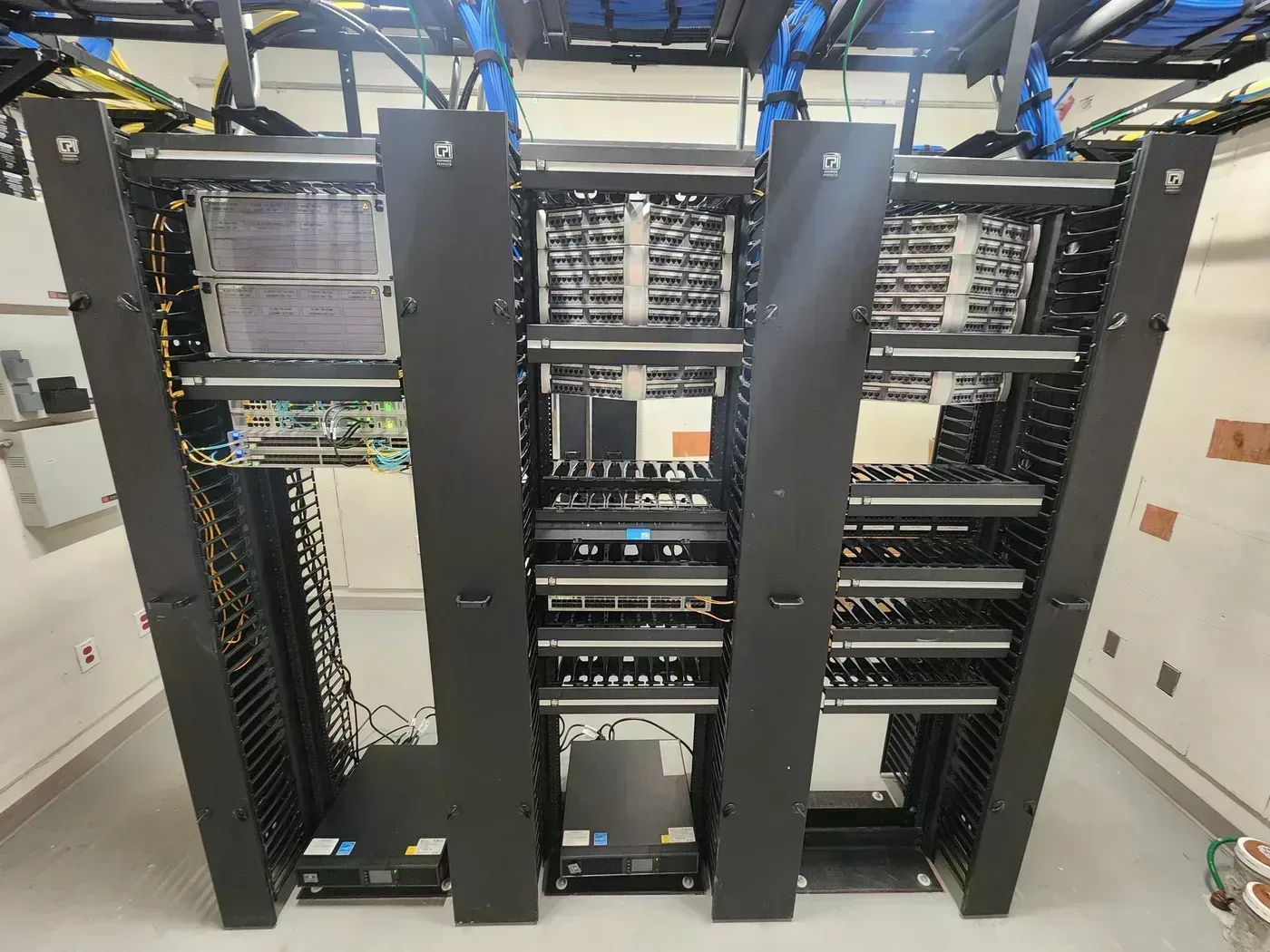
A typical commercial MDF in a 30,000 to 100,000 sq ft Tampa Bay building contains a defined equipment stack. The specifics vary by manufacturer preference and project budget, but the categories are consistent.
- 01A 19-inch rack. Either a 2-post open relay rack (Chatsworth and similar BICSI-style references are common) or an enclosed cabinet from a manufacturer like APC when physical security or thermal containment matters.
- 02Patch panels in 24-port or 48-port Cat6A from one of the major commercial cabling brands such as CommScope, Panduit, or Leviton. Cat6A is the current commercial default for new work.
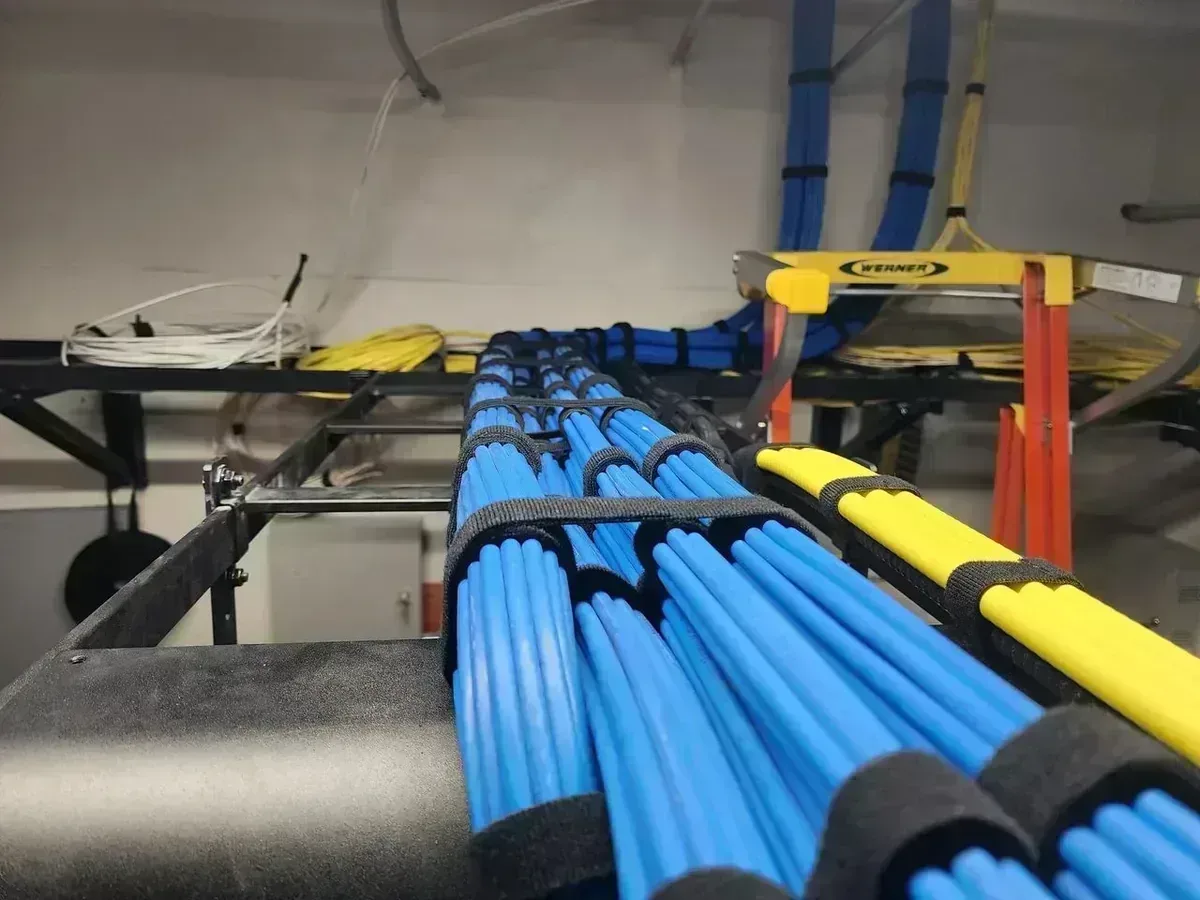
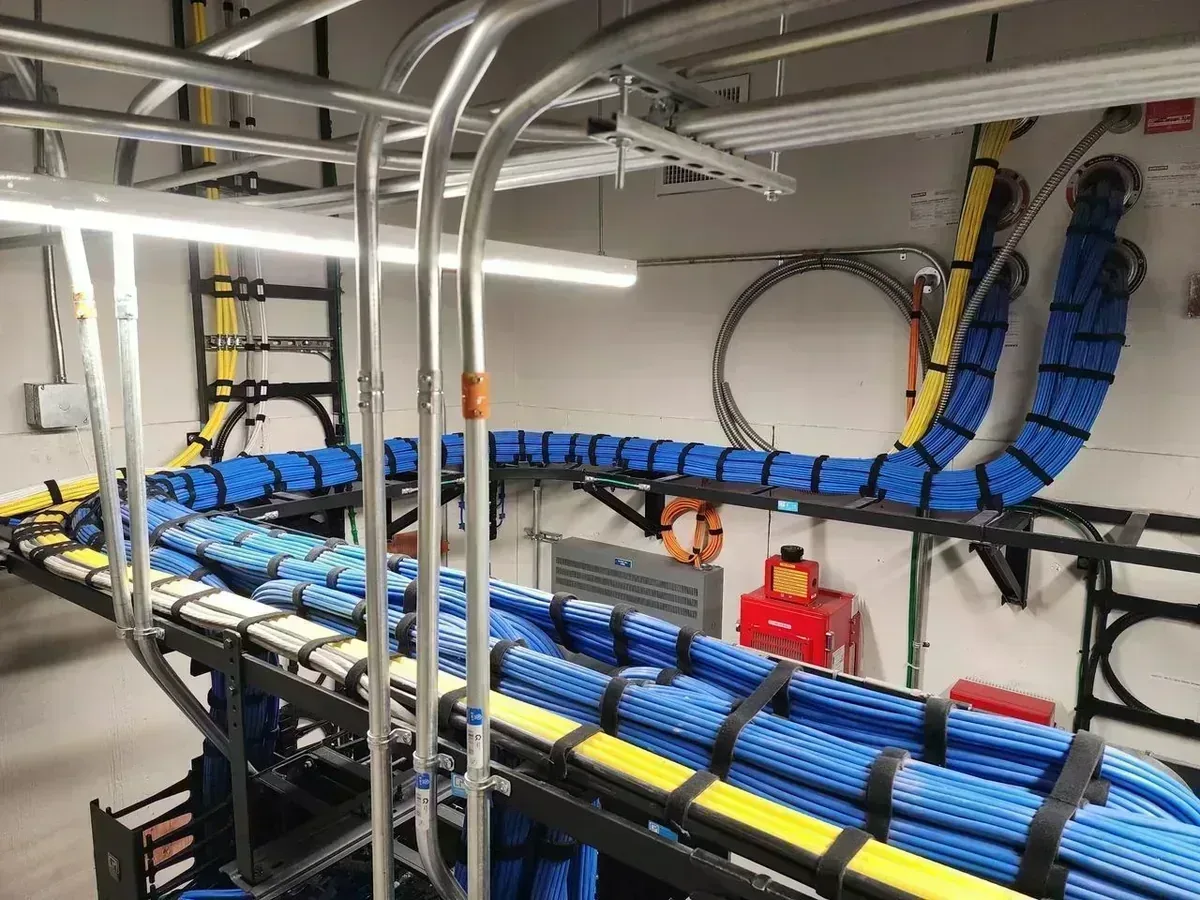
- 03Vertical and horizontal cable management. Velcro on patch cords, never zip ties. Zip ties crush the jacket and break NEXT performance.
- 04A core switch from the enterprise lines: Cisco Catalyst 9300, HPE Aruba CX 6300M, or Juniper EX4400 are the three common choices for the 48-port PoE+ class.
- 05A UPS sized at 1.5x connected load for 15 to 20 minutes of runtime. APC Smart-UPS or Eaton 9PX families are typical, sized up to the rack count.
- 06Fiber distribution housings (LIU enclosures, splice trays, pigtails). Strand count drives the cost; backbone-heavy installs with hundreds of strands add up quickly on the fusion-and-certification labor alone.
- 07A Telecommunications Grounding Busbar (TGB) per TIA-607-D, bonded to the building's Telecommunications Main Grounding Busbar (TMGB) via a #6 AWG minimum conductor.
The room itself typically also includes plywood backboard on at least one wall for mounting termination blocks, fire alarm interface panels, or service provider equipment that does not rack-mount. Lighting is overhead fluorescent or LED, controlled by a switch (not a dimmer) near the door, on a circuit separate from the telecom equipment.
TIA-569, Not TIA-568, Governs the Room Itself
This is the most common technical mistake in MDF room writeups. ANSI/TIA-568 is the cabling standard family. It tells you what gets installed in the room and how to terminate it. The physical room itself, its size, doors, lighting, floor loading, and environment, falls under ANSI/TIA-569-E with Addendum 1 covering temperature and humidity harmonization with ASHRAE.
Section 5 of TIA-569-E sets the floor for an equipment room. The minimum size is 14 m² (150 ft²). The door is 36 in by 80 in, with no sill, hinged outward or removable, lockable. The floor must support a minimum of 50 lbf/ft² distributed, which matters because a fully loaded 4-post rack can exceed 2,000 pounds. Lighting must be at least 500 lux (50 foot-candles) measured one meter above finished floor in the aisles between cabinets. Temperature is governed by ASHRAE TC 9.9 Class A1 through A4, with the recommended operating envelope at 64 to 81 °F and humidity at 60% RH maximum.
Sizing scales with building area. For buildings up to 10,000 m², the main telecom room must be at least 9 m². Above 10,000 m², it must be at least 1% of net floor area or 18 m², whichever is greater. Multi-rack installations or rooms that double as a small data center invoke ANSI/TIA-942-C in addition, with its Rated-1 through Rated-4 redundancy classifications. Small commercial MDFs do not need a TIA-942 rating, but customers with uptime requirements will reference it.
If a writeup says the MDF must follow TIA-568, the writer is conflating cabling with rooms. TIA-568 governs the cables. TIA-569 governs the room. Both apply; they answer different questions.
MDF vs IDF: When You Need Both
The 100-meter limit on twisted-pair horizontal copper drives this decision. Cat6A, Cat6, and Cat5e all top out at 100 meters end-to-end between the switchport and the wall jack, including patch cords. If any user workstation in the building is more than approximately 90 meters of cable run from the MDF, that workstation needs an IDF closer to it. The 10-meter buffer covers patch cord lengths and routing inefficiencies.
Multi-story buildings almost always need IDFs per floor because the riser pathway adds vertical distance that the horizontal cable budget cannot absorb. Single-story buildings over roughly 25,000 sq ft typically need at least one IDF in addition to the MDF, depending on the floor plan and where workstations are clustered. When IDFs exist, the MDF holds the core switch, the IDFs hold access or distribution switches, and a fiber backbone connects them. Fiber removes the 100-meter horizontal limit and lets the building scale to as many IDFs as the budget supports. For a deeper breakdown, see the IDF closet guide and the telecommunications room standard.
Code Requirements That Affect the Room
Florida adopts the National Electrical Code (NFPA 70) by reference under Florida Building Code Chapter 27. For an MDF, three NEC articles matter most. Article 800 governs communications circuits. Section 800.133(A)(1)(c) requires separation between communications cables and electric light/power conductors. The practical numbers, typically at least 12 inches parallel for unshielded power, come from TIA-569. Article 770 governs optical fiber, with parallel listings to copper: OFNP for plenum, OFNR for riser. Section 800.179 sets the copper listings: CMP (plenum) > CMR (riser) > CMG/CM (general). Plenum is required where cable runs in an air-handling space — see the plenum vs. riser cable breakdown for the cable-jacket compositions and where each is acceptable.
NFPA 75 (Standard for the Fire Protection of Information Technology Equipment, 2024 edition) requires the MDF room to be separated from other occupancies by construction with a minimum one-hour fire rating in fully sprinklered buildings of NFPA 220 Type I or II construction. Every conduit, cable tray, or sleeve penetrating that rated wall must be sealed with a UL-listed firestop system matching the wall's hourly rating. Sprinklers stay; the building's pre-action zone usually covers the MDF. Clean-agent suppression (FM-200, Novec 1230) is optional and adds material cost to the room scope, typically reserved for rooms where the equipment value or data-loss exposure justifies it.
Grounding follows TIA-607-D. A Primary Bonding Busbar (PBB) lives in the MDF. A Secondary Bonding Busbar (SBB) lives in each IDF. They are connected by the Telecommunications Bonding Backbone (TBB), a #6 AWG minimum copper conductor that bonds the telecom system to the building's main grounding electrode system.
Environmental Requirements
ASHRAE TC 9.9 Class A1 through A4 thermal envelopes drive temperature and humidity targets. The recommended operating range is 64 to 81 °F at 60% RH or less. A single-rack MDF with two PoE switches and a UPS typically dissipates 3 to 5 kW, which is handled by a small dedicated mini-split sized for the heat load plus a margin.
Tampa Bay's environmental story is humidity rather than heat. Ambient relative humidity in summer routinely exceeds 70% outdoors. A mini-split sized only for cooling will run cold but condense moisture poorly, leaving the MDF damp. The fix is sizing for dehumidification load on top of sensible cooling load, which adds to the HVAC line item versus a dry-climate baseline. Direct-coastal buildings (within a few hundred yards of open water) see accelerated corrosion on bare metal hardware and benefit from galvanized or stainless ladder rack; most of Pinellas and Hillsborough sit inland of that band and the salt-air issue does not really apply.
Real Installed Cost Ranges
Pricing on a commercial MDF buildout is scope-driven, and the spread is wide. The ranges below are what national contractor surveys publish for ballpark planning. Actual project numbers depend on switch class, fiber strand count, occupied-hour labor, and redundancy posture, and they should be confirmed against a real bid before they go into a budget.
- 01A single-rack, 100-drop MDF buildout typically falls in the mid five figures all-in (rack, patch fields, core switch, UPS, fiber distribution, the Cat6A drops themselves, grounding, and labor).
- 02A 500-drop project across an MDF plus two to four IDFs typically falls in the low-to-mid six figures, the increase driven by the inter-room fiber backbone, aggregation switching, and redundant power.
- 03Clean-agent fire suppression (FM-200, Novec 1230) is a separate scope item with its own bid; small telecom rooms are an order of magnitude cheaper than full data-center-sized rooms.
- 04Dedicated mini-split HVAC is a separate trade with its own contractor and quote, sized to the heat load plus dehumidification margin.
Major cost drivers beyond drop count: distance from the utility entrance for the fiber pull (campus or inter-building runs can be substantial), whether the design needs a distribution layer above the core (an additional switch tier roughly doubles the switching spend), redundancy requirements (dual UPS, dual core, dual fiber paths add a meaningful percentage to the total), and whether work happens during occupied hours (occupied-hour labor carries a premium). Plenum-rated cable in retrofit ceilings adds to the per-drop cost compared to new-construction installs.
Ongoing MDF Management
Building the room right is the start. Keeping it working is the discipline that matters over years. Sunbird DCIM has outlined ten operational practices that distinguish well-run MDFs: scheduled cable hygiene, tracked port utilization, photographic before-and-after documentation when changes happen, and remote visibility for distributed sites. Field documentation of MDF rebuilds, like the patch-field-by-patch-field re-cabling coverage from Cabling Installation & Maintenance, shows why the operational discipline matters. An MDF that has to be rebuilt every five years because nobody could trace the patch fields is one that wasn't maintained, not one that wasn't built right.
Florida-Specific Considerations
Florida Building Code, 8th Edition (2023), Chapter 27 adopts NEC by reference. No Florida-specific deviation applies to communications wiring methods. Permits for commercial MDF buildouts are required in City of Tampa, Hillsborough County, and Pinellas County, though small rack-only retrofits in existing rated rooms sometimes qualify for minor work status at AHJ discretion. The contractor pulling permits must hold a Florida DBPR Certified Limited Energy Systems (ES) license or a Specialty Electrical Contractor license. Sole-source structured cabling without that license is unlicensed contracting under Florida Statute 489.
Flood-zone siting matters for buildings in FEMA Zone AE or VE areas of coastal Pinellas and Hillsborough. The MDF must not sit below base flood elevation, both for code reasons and because TIA-569 explicitly prohibits placement below water level. Interior core rooms above grade are the conventional placement for hurricane resilience, even though Florida's High Velocity Hurricane Zone provisions (which require enhanced construction methods) apply only to Miami-Dade and Broward. Hurricane-prone construction tends to put MDFs in interior load-bearing core rooms by owner specification, not by code requirement.
Frequently Asked Questions
Frequently Asked Questions
An MDF is the network distribution hub: service entrance, core switch, backbone cabling origin. A server room houses application servers, storage, and compute. Many small commercial buildings combine the two in one space. Larger buildings separate them because servers run hotter and need different cooling, fire suppression, and physical security profiles. TIA-942 governs server rooms and data centers. TIA-569 governs the MDF.
TIA-569-E sets a 14 m² (150 ft²) floor for an equipment room serving a small building. The practical rule is 1% of total net floor area for the main telecom room, with 18 m² as the minimum once the building exceeds 10,000 m². A single-rack 100-drop installation fits in 150 ft² if the room is laid out with adequate clearance for rack access and cable bending radius.
Yes, with care. The cabling separation rules in NEC 800.133 and TIA-569 mean the wall acts as the separator. If the shared wall holds an electrical panel or transformer, the MDF rack should sit on the opposite wall to keep cabling out of induced EMI fields. Most installers prefer the MDF to be in an interior dedicated room with no exterior wall and no shared utility room access.
For a typical small to mid-size commercial MDF, no. The building's pre-action sprinkler zone covers the room, and NFPA 75 only requires fire-rated separation, not clean-agent suppression. Clean-agent (FM-200, Novec 1230) is added when the equipment value, the data-loss cost of getting hit with water, or the customer's uptime requirements justify the $5,000 to $40,000 install cost.
The demarcation point is the physical boundary between the service provider's network and the customer network. In a small building, the demarc and the MDF can be the same wall jack or fiber panel. In a larger building, the demarc is usually a separate Entrance Facility (TIA-568 calls it the EF) that hands off to the MDF over a short cable run. The MDF is where the customer's switching and routing equipment lives. The demarc is just the responsibility boundary.
For the cabling system: ANSI/TIA-568.0-E and the relevant component standards (TIA-568.2-D for copper, TIA-568.3-E for fiber). For the room: ANSI/TIA-569-E with Addendum 1. For bonding and grounding: TIA-607-D and BICSI/NECA 568-2017. The BICSI Telecommunications Distribution Methods Manual (TDMM 15th Edition) is the comprehensive design reference. A contractor designing without referencing those standards by section number is guessing.
The permit applicant must hold a Florida DBPR Certified Limited Energy Systems (ES) license or a Specialty Electrical Contractor license. Permit packages typically include plans showing rack placement, conduit routing, grounding details, fire-stopping at penetrations, and the calculated load on the dedicated branch circuits. City of Tampa, Hillsborough, and Pinellas all require an inspection before energization. Smaller rack-only retrofits in existing rated rooms can sometimes proceed as minor work at AHJ discretion.
Building an MDF or IDF Room?
TSS USA designs and builds MDF and IDF rooms across Tampa Bay — racks, patch fields, fiber distribution, grounding, and the inter-room backbone. We hold the Florida Limited Energy Systems license required for commercial low-voltage permits in Hillsborough, Pinellas, and surrounding counties.
Get a Structured Cabling Quote